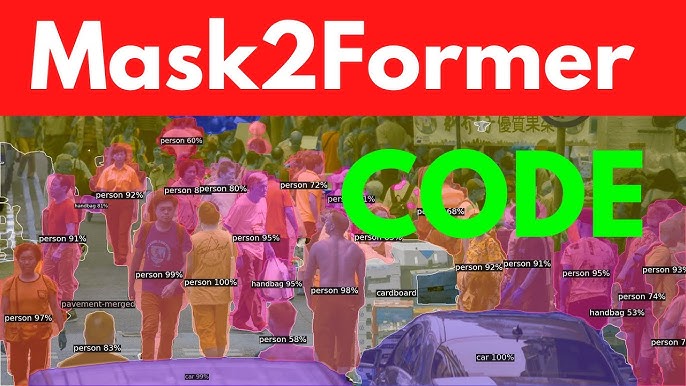

Mask2Former represents a groundbreaking advancement in computer vision, particularly for image segmentation tasks. Developed as a universal architecture for segmentation, it tackles instance, semantic, and panoptic segmentation with remarkable efficiency. Researchers and developers are drawn to its versatility, prompting widespread curiosity about its accessibility. A key question emerges: is Mask2Former open source? Understanding its availability is crucial for those eager to leverage its capabilities in projects or academic pursuits.
The open-source nature of a tool like Mask2Former can significantly impact its adoption. Open-source software fosters collaboration, allowing developers to modify, improve, and share code freely. This accessibility often accelerates innovation, as seen in many machine learning frameworks. For Mask2Former, its open-source status could determine whether it becomes a go-to solution for segmentation tasks or remains limited to specific use cases.
This article explores Mask2Former’s open-source status, its licensing, implementation details, and implications for developers and researchers. By examining its availability, technical aspects, and community support, we aim to provide clarity. Whether you’re a developer seeking to integrate Mask2Former or a researcher studying its architecture, this guide offers a comprehensive look at its accessibility and potential.
What Is Mask2Former?
Understanding Mask2Former’s Purpose
Mask2Former, developed by Meta AI, is a transformer-based model designed for universal image segmentation. It unifies instance, semantic, and panoptic segmentation into a single framework, reducing complexity. Its architecture leverages masked attention to process images efficiently, delivering state-of-the-art performance. This versatility makes it appealing for applications like autonomous driving and medical imaging.
Evolution from Previous Models
Mask2Former builds on its predecessor, MaskFormer, by introducing improvements in efficiency and accuracy. While MaskFormer unified segmentation tasks, Mask2Former enhances scalability and performance on diverse datasets. Its transformer-based approach addresses limitations of traditional convolutional neural networks. This evolution reflects a shift toward more flexible, general-purpose vision models.
Key Features of Mask2Former
The model excels in handling multiple segmentation tasks with a single architecture. It uses a masked attention mechanism to focus on relevant image regions, improving computational efficiency. Mask2Former supports various datasets, including COCO and ADE20K, achieving high accuracy. Its design prioritizes modularity, making it adaptable for custom applications.
Is Mask2Former Open Source?
Official Release and Licensing
Mask2Former’s open-source status is confirmed by Meta AI’s release of its code and weights. The model is available under the MIT License, a permissive license allowing modification and distribution. This accessibility enables developers to use Mask2Former freely in commercial and non-commercial projects. The official repository, hosted on GitHub, includes detailed documentation for implementation.
Benefits of Open-Source Availability
The open-source nature of Mask2Former offers significant advantages for the AI community:
- Collaboration: Developers can contribute to improving the model’s performance.
- Customization: Users can adapt the code for specific tasks or datasets.
- Transparency: Open code allows scrutiny of the model’s inner workings.
- Accessibility: Free access lowers barriers for researchers and startups.
- Community Support: A growing community shares resources, tutorials, and pre-trained models.
Accessing the Codebase
The Mask2Former codebase is publicly available on GitHub, hosted by Meta AI. It includes pre-trained models, training scripts, and evaluation tools. Users can clone the repository and follow setup instructions to integrate it into their workflows. The repository also provides examples for running inference on custom datasets, making it user-friendly.
How to Use Mask2Former
Setting Up the Environment
To use Mask2Former, developers need a compatible environment with Python, PyTorch, and dependencies like Detectron2. The GitHub repository provides a detailed setup guide, including installation commands. A GPU is recommended for faster training and inference. Users must ensure their system meets hardware requirements for optimal performance.
Running Pre-Trained Models
Mask2Former offers pre-trained models for various segmentation tasks, downloadable from the official repository. These models support datasets like COCO and Cityscapes. Users can run inference on images or videos with provided scripts. The process involves loading the model, configuring parameters, and processing input data for segmentation outputs.
Customizing for Specific Tasks
Developers can fine-tune Mask2Former for custom datasets or tasks. The model’s modular design allows adjustments to layers, hyperparameters, or attention mechanisms. Fine-tuning requires preparing annotated datasets and modifying training scripts. This flexibility makes Mask2Former suitable for specialized applications like medical imaging or satellite imagery analysis.
Technical Details of Mask2Former
Architecture Overview
Mask2Former employs a transformer-based architecture with a backbone like ResNet or Swin Transformer. It uses masked attention to focus on specific image regions, reducing computational overhead. The model generates mask predictions for segmentation tasks, leveraging a unified loss function. This design ensures efficiency across instance, semantic, and panoptic segmentation.
Training and Datasets
Training Mask2Former requires large-scale datasets like COCO, ADE20K, or Cityscapes. The model supports supervised learning with annotated images. Its training pipeline includes data augmentation, loss optimization, and evaluation metrics like mean IoU. Users can replicate training using scripts provided in the repository, though significant computational resources are needed.
Performance Metrics
Mask2Former achieves top results on benchmarks like COCO and ADE20K. For instance, it reports high AP (Average Precision) for instance segmentation and mIoU (mean Intersection over Union) for semantic segmentation. Its efficiency stems from optimized attention mechanisms, reducing inference time. These metrics highlight its superiority over earlier models like MaskFormer.
Community and Support for Mask2Former
Active Developer Community
The open-source release has fostered a vibrant community around Mask2Former. Developers share insights, code snippets, and tutorials on platforms like GitHub and forums:
- GitHub Issues: Users report bugs or seek help with implementation.
- Tutorials: Community members publish guides for setup and fine-tuning.
- Forums: Discussions on Reddit and Stack Overflow address common challenges.
- Contributions: Developers submit pull requests to enhance the codebase.
- Pre-Trained Models: Community-shared models expand available resources.
Resources for Learning
Numerous resources support learning Mask2Former. The official repository includes documentation, example scripts, and model checkpoints. Online tutorials on platforms like YouTube or Medium explain setup and usage. Academic papers, including the original Mask2Former publication, provide technical insights. These resources cater to both beginners and advanced users.
Support from Meta AI
Meta AI actively maintains the Mask2Former repository, providing updates and bug fixes. The team responds to community feedback via GitHub issues. Official documentation covers installation, usage, and troubleshooting. While direct support may be limited, the open-source model encourages community-driven assistance, ensuring users have access to help.
Implications of Mask2Former’s Open-Source Status
Impact on Research and Development
The open-source availability accelerates research by enabling experimentation:
- Innovation: Researchers can build on Mask2Former for new algorithms.
- Reproducibility: Open code ensures studies can be replicated.
- Accessibility: Free access supports academic institutions with limited budgets.
- Collaboration: Global researchers contribute to advancements.
- Benchmarking: Open models allow fair comparisons with other architectures.
Commercial Applications
Businesses benefit from Mask2Former’s open-source status for developing applications. Its permissive license allows integration into products like autonomous vehicles or surveillance systems. Companies can customize the model without costly licensing fees. The availability of pre-trained models reduces development time, making it cost-effective for startups and enterprises.
Future of Open-Source Vision Models
Mask2Former’s release reflects a broader trend toward open-source AI models. As companies like Meta AI share advanced tools, the computer vision field advances rapidly. Open-source models democratize access, fostering innovation across industries. Mask2Former’s success may inspire more organizations to release their models, shaping the future of AI development.
Conclusion
Mask2Former’s open-source status under the MIT License makes it a powerful tool for developers and researchers. Its accessible codebase, hosted on GitHub, supports customization and collaboration, driving innovation in image segmentation. With a vibrant community and robust resources, it empowers users to tackle diverse applications. From academic research to commercial products, Mask2Former’s availability accelerates progress, solidifying its role as a cornerstone in computer vision advancements.